
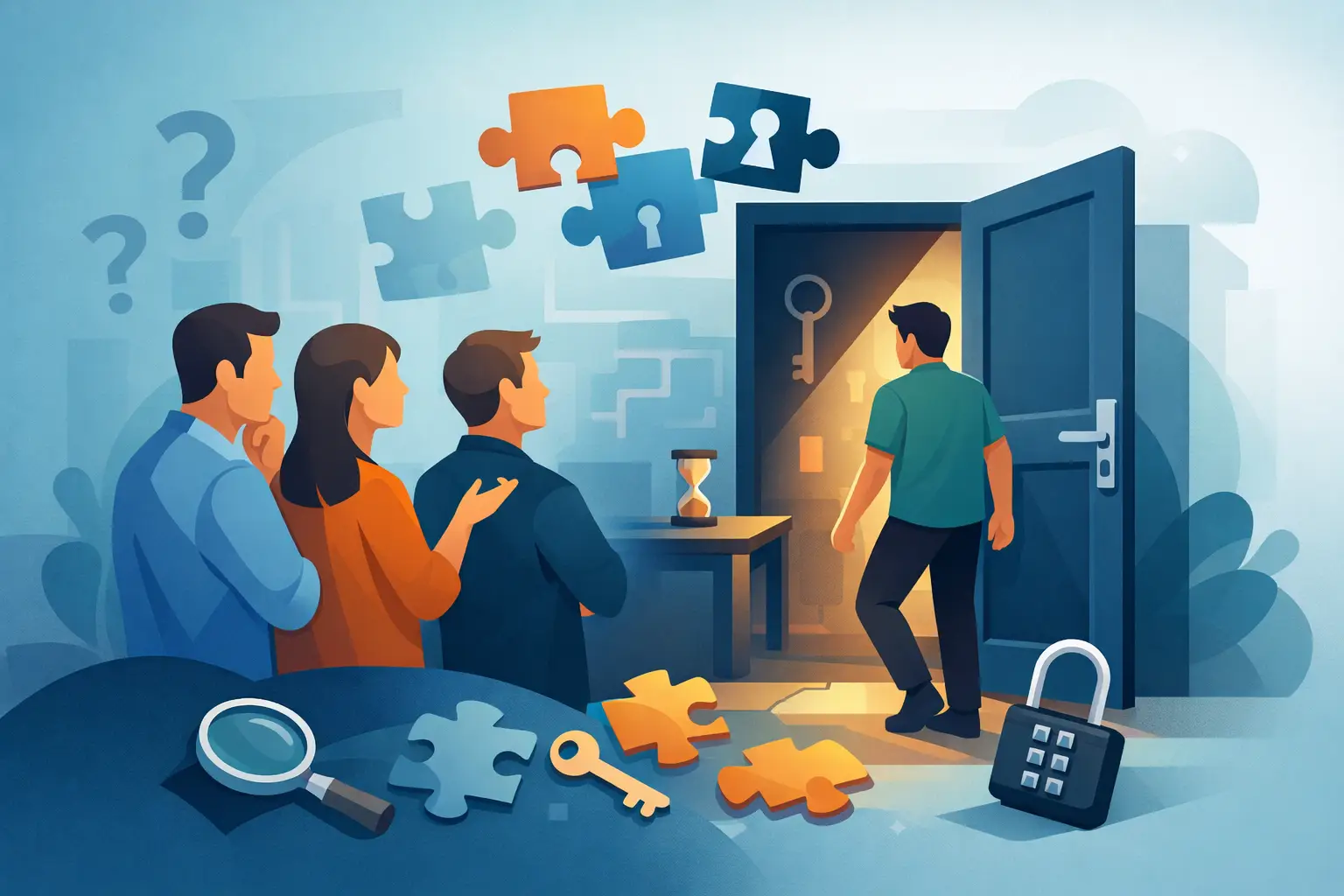
A lot is decided in the first minute. Not just whether you’ll make it out in time, but also how dynamic, cinematic, and truly shared the experience will feel. And surprisingly, one factor plays a big role in that: how many people walk into the room with you.
So the question is completely valid: how many people should an escape room team have? The short answer is that there isn’t a single perfect number for every situation. The ideal team size depends on the type of game you’re playing, how well you know each other, how experienced you are, and whether you want everyone to stay actively involved the whole time—or you’re simply looking for a big shared adventure.
What is the ideal escape room team size in general?
Most modern escape rooms are designed for 2–8 players, but that doesn’t mean every group size is equally good. The technical maximum and the ideal team size are not the same thing.
In general, a team of 3–5 people offers the best balance. There are enough eyes in the room, different ways of thinking come together, and yet it’s unlikely that someone will just drift along without participating. This size works especially well if you want the game to be more than just visually impressive—if you want everyone to have tasks, moments of success, and a few memorable “aha” moments.
Of course, there are exceptions. A large, cinematic game with multiple rooms can easily accommodate 6–8 players, while a smaller, classic puzzle room usually works better with fewer people. In a fast-paced, dynamic experience, a bigger team isn’t necessarily a disadvantage—in fact, it can add to the atmosphere.
When is a 2-person team a good choice?
Playing as a pair is a very different experience. There’s nowhere to step back and no one else to rely on to solve things. Every discovery, every decision, and every mistake depends directly on the two of you. Because of that, the game often feels more personal, focused, and intense.
For couples, close friends, or people who enjoy thinking together, it can be a fantastic choice. Communication is faster, there’s less debate, and the pace can feel tight and efficient.
On the other hand, the pressure is much higher. If the room contains many parallel tasks, a large space, or a fast tempo, two players can easily become overloaded.
For beginners, this setup isn’t always the most comfortable entry point. Not because it’s impossible to complete, but because there’s less margin for error. If you’re planning your first escape room together and prefer a relaxed experience rather than maximum concentration, 3–4 players might be a friendlier start.
The experience often comes together best with 3–4 players
If we had to name one team size that works well for most groups, it would be 3–4 players.
At this point, you can divide your attention, split up to explore different clues, and then combine the information—while everyone still stays actively involved in the game.
This team size works especially well for groups of friends, smaller families, and players trying their first or second escape room. It’s not too many people and not too few ideas. Communication remains clear, the pace stays dynamic, and it’s less likely that someone will end up being just a spectator.
In story-driven, visually rich games, this number also works well because you can immerse yourselves in the environment while still making steady progress on the puzzles. The space doesn’t feel crowded, and the joy of discovery doesn’t get diluted.
With 5–6 players, the energy increases
A team of 5–6 players is noticeably louder, more energetic, and more lively. There are more reactions, more ideas, and usually more laughter happening at the same time.
If the game includes large spaces, lots of stimuli, and multiple puzzles running in parallel, this team size can work very well.
However, there is a point where adding more people doesn’t automatically add more fun. If the pace within the group varies greatly, some players might dominate the solutions while others fall behind. This often happens when several people speak at once and the team lacks a natural rhythm.
That’s why 5–6 players works best when the group already knows how to cooperate. For company teams, birthday programs, or well-established friend groups, this setup can be a perfect fit. The experience often feels more spectacular, more eventful, and truly shared.
What about large groups of 7–8 people?
A 7–8 player team is a special case. It can be fantastic—but only if the game itself is designed to handle that many people.
In a large, heavily themed experience with multiple simultaneous tasks, a big team can bring enormous energy to the game. It can feel like you’ve all stepped together into an action movie.
In smaller or more linear rooms, however, 7–8 players can easily be too many. Some people may end up waiting, observing, or missing key moments. The beauty of escape rooms is being inside the story—not watching from the corner while two or three players solve everything.
For large groups, it’s worth thinking not only about whether the room allows that many players, but also about the kind of experience you want. If the goal is a shared activity and a fun atmosphere, a big team can work well. But if you want everyone to actively solve puzzles, it’s often better to split into two teams.
Experience level also makes a difference
The ideal team size also depends on experience.
For beginners, slightly larger groups can provide a sense of security. More ideas, more eyes, more chances to notice things. A 4–5 person beginner team usually feels more comfortable than a team of two.
Experienced players, however, often prefer smaller teams. They already know how to search effectively, communicate clearly, and work in parallel, so even 2–3 players can maintain a strong pace. For them, a smaller team isn’t necessarily a challenge—it’s often a conscious choice because it keeps them fully involved in every moment.
If the team is mixed, with both beginners and experienced players, 4–5 people is usually an ideal compromise. The more experienced players can help keep the momentum going, while newer players don’t feel lost.
The relationships within the team matter too
It’s not just about numbers—it also matters who the players are.
A group of four close friends and a group of four colleagues who barely know each other may behave very differently in the same room. Familiarity helps a lot. If you know each other’s reactions, communication becomes easier, shared thinking becomes faster, and the overall experience tends to be richer.
For families, for example, raw performance is rarely the main goal. The important thing is spending a memorable hour together, which means a slightly larger group can still work well.
For groups of friends, the focus is often on excitement and the shared sense of success—here, 3–5 players works extremely well.
For corporate events, the key factor is engagement. No one wants to feel like an extra in their own team-building activity.
What should you consider before booking?
The best decision comes from considering not only the team size, but also the type of game.
A cinematic, large-scale experience can usually handle more players. A smaller, puzzle-focused room often works better with fewer people.
It’s also worth thinking about your goal. If you want a more intimate, focused challenge, go with a smaller team. If the shared adventure, reactions, and atmosphere matter more, a larger group can be a great choice.
A truly memorable escape room isn’t defined by how many people are inside—it’s defined by whether everyone feels like they’re part of the story.
If you choose a game designed to support multiple team sizes, it’s much easier to find the ideal number. In these rooms, the space, gameplay, and pacing are built so that you don’t just fit inside—you actually experience the adventure.
That’s exactly what makes the difference between an average activity and a 60-minute experience people talk about for days afterwards. If you want to play it safe, it’s worth choosing a premium game where the theme, visuals, and team size are truly aligned, such as the experiences offered by AROOM Budapest.
So the best team size isn’t a fixed number. It’s the point where no one in your group feels left out of the experience. Once you find that balance, an escape room stops being just a program—and becomes a shared story.